Promoting better nutrition, education and foundational opportunities for vulnerable children and widows of East Africa through the lens of the Christian gospel. We aim to connect people and resources from vast distances with an ultimate goal to improve the lives of the oppressed and forgotten.
A monthly gift of $39 can make a direct impact, providing school supplies, meals, medical care and mentorship to a child or older student in need.
Late summer and early autumn is a very busy time for our Kenya Now team. From manning info tables at festivals to putting on fundraisers and concerts, it has been quite the month! Fortunately, we are settling back down to our basal rate of activity. First, I would like to say thank you to the 16 supporters who have filled out our communications survey. I am going to keep it open over the weekend and would appreciate more input before I compile the submissions and present it to our board of directors next week. Fill it out HERE. It only takes around 30 seconds! Happenings at the Rebirth Academy & Children's Home There is never a dull moment at the orphanage. The kids are well cared for and happy. They always look forward to our Virtual Enrichment Classes, where they get to spend 45 minutes interacting with our volunteers as we read them books and teach on fun enrichment topics. This past Tuesday, I explored meat eating plants with them and showed them some epic BBC videos of Venus Flytraps coming to life to take a life... poor fly! There are no computers or established internet at the school. We teach over an iPad that sits at the front of the classroom filled with 160 eager students. It is always a blast. You can join in on a session if you want to see what it is like. Email me to join the next class: dan@kenyanow.org We have a new resident at the orphanage. Her name is Faith. She is a 14 year old girl who was dropped off by her mother, who was desperately pleading for us to take her child. The mother made little sense through her hysteria, so we allowed the girl to stay overnight as a safe haven until we could investigate further and determine the best action to take. That was 3 weeks ago, and the mother is nowhere to be found. We have learned that the father had died and the stepfather was terribly abusive, though a lot remains a mystery. The local authorities are involved, and we have formally accepted her at the orphanage. She is currently attending our Rebirth primary school until we can enroll her into an outside secondary school (we only have a primary school and outsource our students to nearby secondary schools). She is in desperate need of a sponsor. The monthly gift does not only help cover her care at the orphanage, but it also pays for school fees, uniforms, and more. Please consider sponsoring her and joining the family of supporters that make our education and children's home program possible. Find her profile HERE. Healthy Child Program Update This leads me to my next update: our school medical clinic initiative. Faith is a very tall girl, and she is very malnourished and likely has never seen a doctor before. That is where our Healthy Child Program comes in. As of 6 months ago, we have a school nurse who has been implementing health initiatives and wellness checks for all of our students in the program. Her name is Bethany (you rock, Bethany!). With her help, we have been able to monitor, treat, and prevent health issues on the compound. This is a major milestone. Bethany is assessing, monitoring, and providing the necessary care for Faith. With our Healthy Child Program combined with our Nutrition Program, I am confident that Faith will thrive and quickly adapt to this new environment. While we have a health program, we do not actually have a stationary clinic. That is where you come in. Help us finish our clinic fundraiser so we can build an onsite clinic, stock it with supplies and medications, and pay our current unpaid nurse. That is right, the only compensation that Bethany receives right now is a small amount to cover rent. We need to compensate her just as we do with the teachers. I am confident we will complete this fundraiser soon, as we are already 50% of the way there. We are going to start building the clinic even though we have not raised all the funding yet. It is that important. If you want to make an impact, this is that opportunity. Find the clinic fundraiser HERE. Spiritual Awakening Project Update I am assuming, and hopeful, that you already know this: Kenya Now is a Christian organization. We do a lot of humanitarian aid, but as a whole, we do it as a calling and with the hope of shining the love of Jesus Christ to those we serve, without prejudice. We are so thankful to our supporters who may not view the world through our same eyes, but decide to partner with us anyway. We are happy to have a diverse group of supporters! However, the Spiritual Awakening Project is special to my wife Kara and I. This is where we support our ministry partner, AMJM, in their church planting and Gospel initiatives. Not a lot of people give toward this project, and I would like to see more traction here. Every dollar donated to this project goes straight to AMJM and their ministry efforts, not to our other programs. If you have been looking for a way to give solely to our Christian mission, this is your stop. Check it out and get involved HERE. Bishop Patroba just returned from visiting one of his churches in Uganda. He has over 30 churches spanning across Uganda, Kenya, and Tanzania, all of which receive no regular financial support. What they do receive is leadership networking, along with supplies such as Bibles whenever they are gifted. We had a donor give toward this trip, and the funds were used to gift sacks of maize to some of the women, many of whom are widows. These moments never fade away and are always powerful. Here is another example of where your gift might go. A few weeks back, Bishop traveled up to the extremely remote desert region of northern Kenya near the border of South Sudan. He was visiting a church that has been asking to join the AMJM network of churches. While there, he was given a tour of the village named Kakuma. "Kakuma" literally means "nowhere" in the local Turkana language, which is fitting for such an isolated area. The town originally grew out of a makeshift refugee camp established in 1992 to shelter the thousands of displaced children known as the "Lost Boys of Sudan" fleeing civil war. Over the decades, that camp expanded to become one of the largest refugee camps in all of Africa. During his visit, Bishop met a woman living with her children in a small hut in Kakuma. Thanks to a donor who gifted money for this trip, Bishop was able to use those funds to buy metal sheets to help her secure her walls. Find a photo of the hut in Kakuma and the Ugandan women with their maize below! Bishop could use your help with his ministry. We will make sure he gets your gift through this project page. As a community of believers, anything is possible!
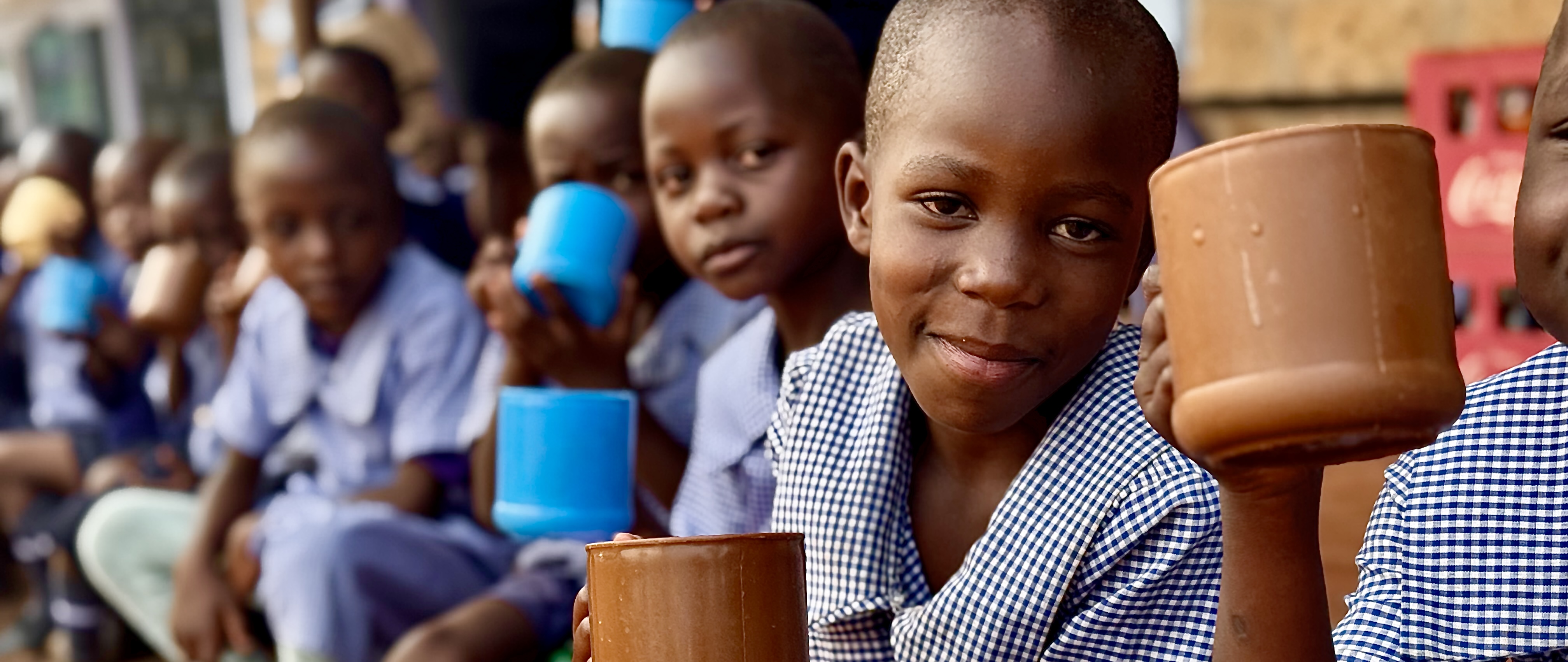
Every morning, the students at Rebirth Academy in Kenya drink their morning tea—a mixture of black tea, milk, and spices that resembles chai in other regions of the world. This is such a staple in the region that a teacher once told me children who don’t have access to morning tea every day are considered very poor. Our students at Rebirth are always provided warmth, not only through their morning tea, but through our compassionate teachers, cooks, and caregivers. How Do We Ensure Tea is Served Every Day? Through our Nutrition Program! Morning tea is just a sliver of what is provided through this vital effort. Nutrition was the very first hurdle my wife Kara and I tackled in the beginning. How can children learn well if they don't eat well? Years ago, many of the children rarely ate meat. When we introduced daily protein, we found that not only did they look healthier, but their learning and focus improved dramatically. That is how important this program is—it covers every aspect of a child's well-being. We are always looking for Nutrition Champions. Is that you? Setting up a monthly gift of nutrition ensures this program never stalls. Set up your monthly gift here Prayer & Support Request: Bishop Patroba Please be praying for our good friend and ministry partner, Bishop Patroba. He will be traveling to Kampala in Uganda to register his ministry of churches in the country. It’s a long, arduous road trip! If you’d like to help him with travel costs, you can do so through our Spiritual Awakening Project. In fact, if you want to solely support the Gospel aspect of Kenya Now, the Spiritual Awakening Project is how to do it! From purchasing Bibles to putting on large church leadership conferences, your gift toward spiritual growth goes a long way. Support the Spiritual Awakening Project Sponsor a Child: Sponsoring a student helps us pay our hardworking teachers, provide school supplies, and ensure our school stays open! Sponsor a student today
Every couple of years, the Kenyan Ministry of Education swings by unannounced to inspect our school and orphanage compound, comb through documents, and grill teachers and staff. Being a nurse, it reminds me a lot of the internal panic hospital staff feel when the Joint Commission rolls up (you know, the people who can literally shut a hospital down). We held our breath... and the final report was outstanding! They were thrilled with all the new buildings, the mural art making the compound so vibrant, the large outfitted kitchen for our nutrition program, and so much more. In fact, they said they rarely see private schools in such great shape. On top of that, they were floored by our Child Protection Policy, which we adapted from UNICEF standards. It’s a comprehensive safeguarding policy that every staff member and volunteer must review and sign off on annually. This glowing report came just in time, as we recently signed a lease for a large piece of property adjacent to our compound to use as a sports field (and with the right funding down the road, we hope to purchase it!). We thank God for all of this progress, and for the women and children whose lives are being changed every single day. This is all made possible because of you. You receive these emails because at one point you decided to partner with us through a sponsorship or a one-time gift. That doesn't go lightly with us. You are a vital member of the Kenya Now family. Event Registration Update! Speaking of moving forward, here is our current attendance count for our upcoming concert and W4KN walkathons across New Jersey, Maine, and New Hampshire: W4KN NJ: 3 W4KN ME: 2 La Claires Concert: 3 Hey, now that’s progress—we only had 1 person for each event last week! Now, if you are anything like me, you might naturally push everything off until the last minute. I like to keep life fluid! Heck, I barely know what I’m doing two days from now. But let's make an exception here... you know, for the kids! We want to see you there. We want to walk with you. We want to get to know you. Will you sign up today? This isn't just a walk—it's energy spent for real change. Sign Up